Key takeaways
- In England, Scotland and Wales, call 105 to report a power cut or get an update. In Northern Ireland the number is 03457 643643.
- The government Be Ready campaign suggests being ready for 3 days, with a torch, spare batteries, a battery or wind-up FM radio and a charged power bank.
- A 1 kWh power station keeps a router going for about 45 hours, or a fridge for about 16 hours.
- Three days of basic needs (router, two lamps, phone) take about 2,100 Wh, so plan to recharge or cut back.
In this article
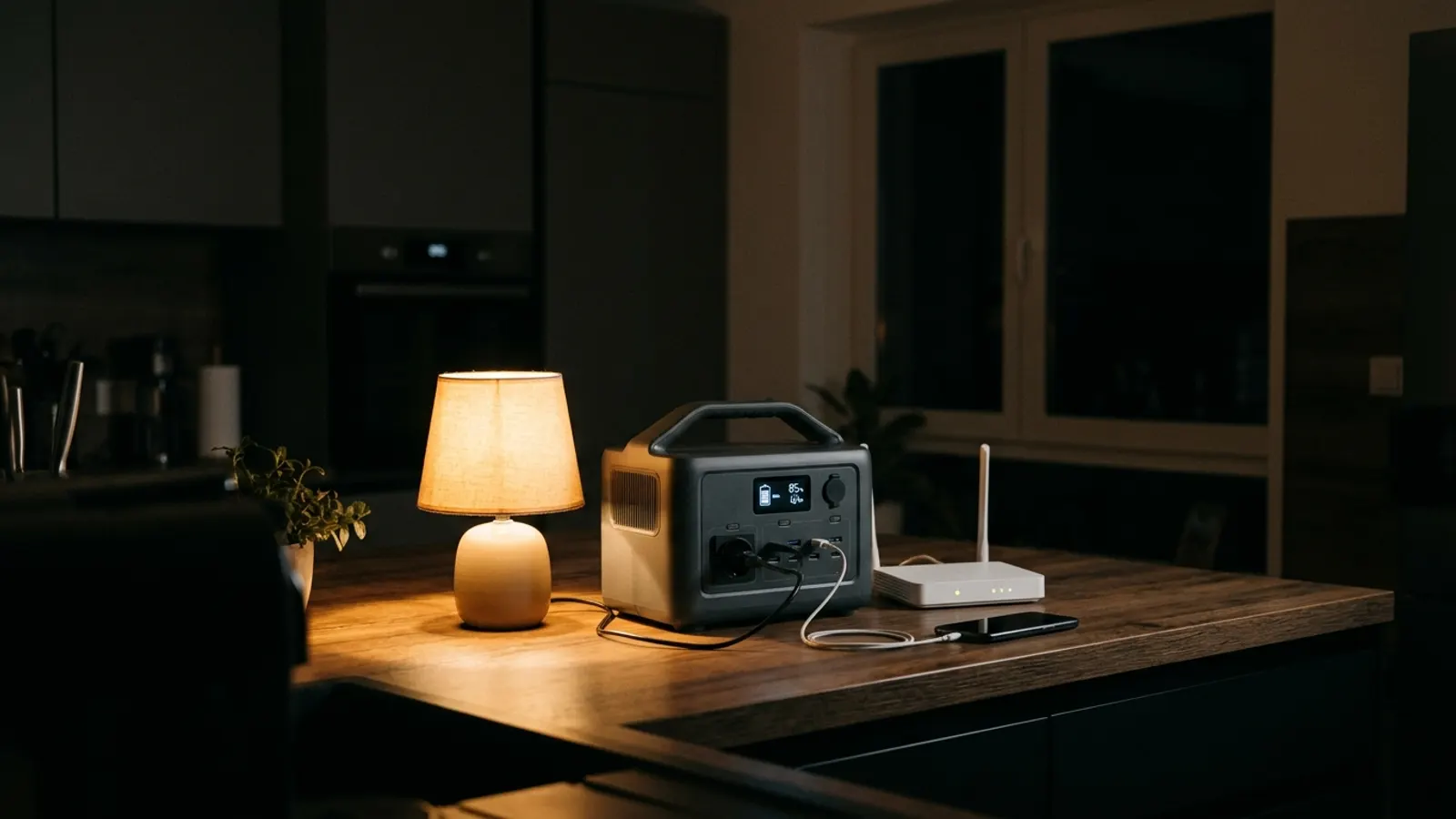
When the power goes off, call 105 to report it and find out how long it may last, then switch to torches, not candles. A portable power station, a big battery with normal UK sockets and USB ports, can keep the router, a lamp, phones and even a fridge going for hours. Here is what to do first, and how many hours you can expect.
The first ten minutes
Check if it is just your home
Look out of the window. If the street lights and your neighbours’ windows are dark, it is a wider cut. If only your home is off, check your fuse box (consumer unit) first, in case a switch has tripped.
Call 105
105 is the free number for power cuts in England, Scotland and Wales. It puts you through to your local network operator, the company that runs the cables in your area, whoever sends you the bill. In Northern Ireland the government’s Be Ready page gives 03457 643643.
The Be Ready advice also says to write important numbers down on paper. When your phone is flat, you cannot look them up.
Light and safety
The Be Ready page says plainly that torches are safer than candles. Keep a torch and spare batteries somewhere you can find in the dark.
Never bring a barbecue, camping stove or petrol generator indoors to cook, heat or make power. The NHS warns that carbon monoxide has no colour and no smell, and that portable generators and engines in closed spaces can cause a build-up.
What the government Be Ready advice asks you to have
The Be Ready campaign suggests being ready for 3 days. For power cuts, the useful items on its checklist are:
- a torch and spare batteries;
- an FM radio that runs on batteries or a wind-up handle;
- a charged power bank, for phones or compatible medical devices;
- blankets, sleeping bags and warm clothes;
- cash, in coins and notes, and your cards.
If someone in your home relies on powered medical equipment, check whether you can join the Priority Services Register. Your network operator then knows you need extra help during a cut.
A power bank charges a phone a few times. A power station does the same job, but it can also run things with a normal plug.
What a power station keeps running
We use one formula across the site: hours = battery Wh × 0.85 ÷ (device watts + 10 W). The 0.85 covers losses when the battery makes 230 V. The extra 10 W is what the station itself uses while its sockets are switched on.
Here are three stations, with the battery size announced by each brand, and the average power of common devices from our own figures:
| Device (average watts) | Anker SOLIX C1000 (1,056 Wh) | EcoFlow RIVER 2 Pro (768 Wh) | BLUETTI EB3A (268 Wh) |
|---|---|---|---|
| Router (10 W) | ≈ 45 h | ≈ 33 h | ≈ 11 h |
| LED lamp (8 W) | ≈ 50 h | ≈ 36 h | ≈ 13 h |
| CPAP, no heated humidifier (12 W) | ≈ 41 h | ≈ 30 h | ≈ 10 h |
| Fridge (45 W) | ≈ 16 h | ≈ 12 h | cannot start it |
| Gas boiler controls and pump (80 W) | ≈ 10 h | ≈ 7 h | ≈ 2.5 h |
To check one line yourself: 1,056 × 0.85 ÷ (45 + 10) = 897.6 ÷ 55 ≈ 16 hours for the fridge.
The EB3A cannot run the fridge. A fridge compressor needs around 700 W for a second when it starts, and the brand announces 600 W for the EB3A’s sockets. The other two announce 1,800 W and 800 W, so they can.
You can try your own mix of devices in the runtime calculator.
Three days, as the government suggests
Our basic day is the router for 24 hours, two LED lamps for 6 hours, one phone for 3 hours, and the station itself switched on all day:
10 × 24 + 8 × 6 × 2 + 10 × 3 + 10 × 24 = 240 + 96 + 30 + 240 = 606 Wh a day.
| Plan | Wh per day | Battery for 3 days (÷ 0.85) |
|---|---|---|
| Basic day | 606 Wh | ≈ 2,140 Wh |
| Basic day + fridge (45 W × 24 h) | 1,686 Wh | ≈ 5,950 Wh |
So a 1 kWh station covers about a day and a half of the basic plan, and well under a day with the fridge. If you want the full 3 days, you need a second battery, a solar panel, or fewer devices.
Easy ways to stretch it
- Charge phones from the USB ports. The station does not need its 230 V sockets for that, so you save the 10 W.
- Switch the sockets off when nothing needs them.
- Keep the fridge door shut and only run the fridge for a few hours at a time.
For a ready-made list, see our emergency kit page.
What a power station cannot do
Heat the house
A kettle draws about 2,000 W on our figures, more than any of these three stations announces for its sockets. Heaters are in the same league, so they are not a job for a station. Plan to keep warm with blankets and layers, as the Be Ready checklist suggests.
Plug into the house wiring
Never connect a power station to a wall socket or to your consumer unit. Plug devices straight into the station. A gas boiler is usually wired into the house, so ask a Gas Safe engineer or a qualified electrician before you try anything with it.
Run forever
Check the charge every few hours and keep it topped up while you still have power. To compare models by battery size and sockets, see the Anker SOLIX C1000 page or the full comparison hub.
In short
- Call 105 in England, Scotland and Wales (03457 643643 in Northern Ireland), and use torches, not candles.
- Keep the Be Ready basics: torch, spare batteries, FM radio, charged power bank, warm clothes and some cash.
- A 1 kWh power station runs a router for about 45 hours or a fridge for about 16 hours.
- Three days of basic needs take about 2,100 Wh, so recharge, add solar or cut back.
Sources
Questions
What number do I call in a power cut?
Call 105 in England, Scotland and Wales. It puts you through to your local network operator, whoever supplies your electricity. In Northern Ireland, call 03457 643643.
Can a portable power station run my gas boiler?
A boiler's controls and pump use little power, about 80 W on our figures, so a 1 kWh station could run it for about 10 hours. But most UK boilers are wired into the house, so only a Gas Safe engineer or qualified electrician should decide how, or whether, to connect one.
Should I use candles in a power cut?
The government's Be Ready advice says torches are safer than candles. A small LED lamp on a power station is another option.
Will my fridge food be safe?
Keep the door shut as much as you can. If you want to keep it running, a station needs enough power to start the compressor, around 700 W for a moment on our figures, and about 1,000 Wh to last most of a day.
Stations in this article
- 1056 Wh · 1800 W Anker SOLIX C1000 Every device with the Anker SOLIX C10001,056 Wh Check price
- 768 Wh · 800 W EcoFlow RIVER 2 Pro Every device with the EcoFlow RIVER 2 Pro768 Wh Check price
- 268 Wh · 600 W BLUETTI EB3A Every device with the BLUETTI EB3A268 Wh Check price
How much battery do you need?
Tick your devices and how long you need to last. The calculator gives you the answer in 30 seconds.
Open the calculator